November 30th, 2014 by Rachel | Tags: Peace Corps | No Comments »
Prior to leaving for Cameroon, someone said to me, “I was told there are no shops in Cameroon.” I certainly thought, “Wow! That’s a crazy stereotype and false information to hear!” Then, since arriving in Cameroon, I have been very thankful to have received a number of lovely care packages from my family members. While most of the items that were included in the packages were food such as Trader Joe’s Cookie Butter, Trader Joe’s Charmingly Chewy Chocolate Chip Cookies, Cheez-Its, Kraft Mac and Cheese, items that are not found or very hard to find in Cameroon, they also included toothpastes. I giggled when I saw toothpastes and thought, “Wow! I really need to educate Americans about shopping in Cameroon.” Colgate, Crest and Oral-B exist on every corner in Cameroon. I can attest that Cameroonians do brush their teeth on daily basis like Americans as I’ve seen my host family members in Mengong brushing their teeth on regular basis.
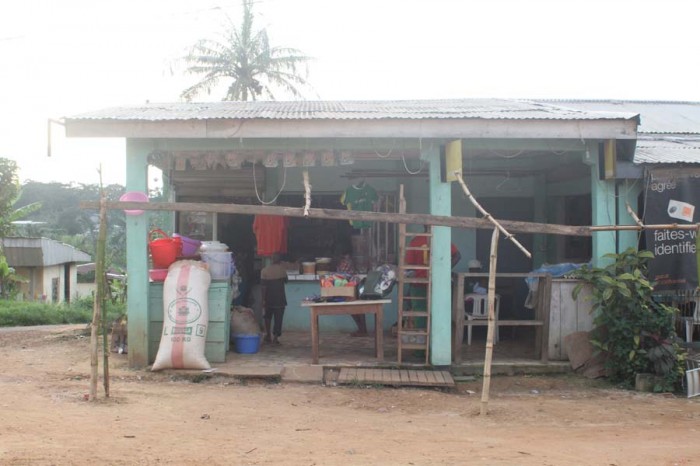
My host mother’s shop in Mengong, which sells a variety of items one would find in a convenient store in the United States.
While big box stores and supermarkets may be hard to find in Cameroon, that does not mean Cameroon is a country of nothing. Instead of having many brand name stores such as Target, Whole Foods, and Macy’s, Cameroon just has more independent shops that are owned by individuals. Even in the very remote villages, small stops still exist. Mengong, a village where I lived for the first two months in Cameroon, have a few shops. Every independent shop sells a particular selection of items. One independent store may focus on selling only kitchen items that one would find in a Bed, Beth and Beyond and Crate and Barrel store while another independent store may focus on selling shoes that one would find in a DSW Shoe store or Nordstrom. There are independent stores that focus on selling convenience items and going to these stores feels like going to a CVS or Walgreens because we can find toothpastes, toilet paper, paper towels, soap, laundry detergent, cereals, and cookies. There are are also shops that exclusively sells office and school supplies and visiting these shops feel like walking inside an Office Depot. While there are shops that sell clothes, there are also shops that exclusively sells pagnes and then there are tailors who will make our own unique clothes. Dove, Nestle, Coca Cola, Guinness, Samsung, Nike, and Durrell are some of many brands that are found in Cameroon.

This is a shelf full of items found inside my host mother’s shop in Mengong.
Outdoor markets are also far more common in Cameroon. Instead of getting into a car, driving to a supermarket to buy food and parking in a big parking lot in the United States, many Cameroonians take motos, bush taxis, or taxis or walk to an outdoor market where they can find wide variety of fresh fruits, vegetables, meat, fish grains and bread from local farms. It’s like visiting an enormous Whole Foods but without the prepared gourmet food section. Instead of seeing signs with fixed prices, we have to ask the sellers the price and negotiate.
When people look at images of Africa and have only seen people struggling to get water, malnourished children, or vast open space of land, they need to realize that these images take place in only some parts of Africa. In many parts of Africa, there are people who do lead lives that are similar to Americans which means that there are people who do work, go to school, go shopping, eat with their families at home, and brush their teeth.
November 26th, 2014 by Rachel | Tags: Disability, Peace Corps | 4 Comments »
I have disabilities. I was born profoundly deaf due to Usher Syndrome, a genetic condition that not only causes deafness but also slow progression of blindness. I was fortunate to receive a technology called cochlear implant at age two and a half years old. I attended therapy weekly to learn to hear and speak. My parents spent many hours helping me develop my listening and spoken language skills.
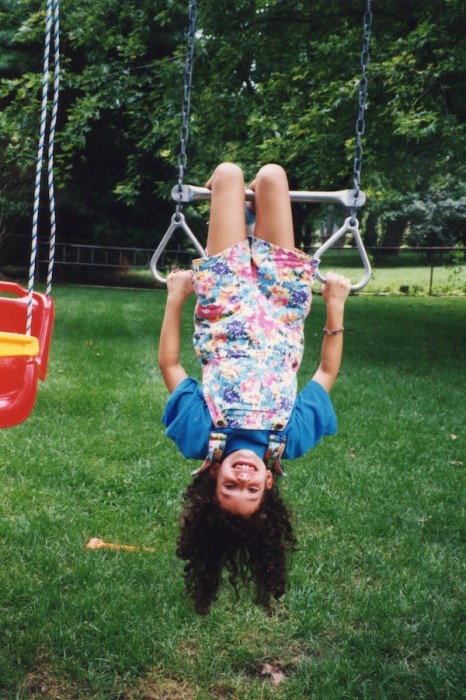
Rachel as a Child
When I was a child, I never went to a school for the deaf or a special school. I went to mainstream school, the same school all kids who heard normally in my neighborhood attended. I was always in the regular classroom and participated in all activities that people with normal hearing did.
Later on in my life, I got a microphone system that consisted a speaker and a microphone for teachers and students to use to help me hear the teachers and students better. I also had support teachers in schools who helped me continue to work on my listening and spoken language skills.
I successfully completed my schooling when I was 19 years old in 2006. I graduated with honors from high school and went onto universities where I successfully completed a bachelors and masters.
I have been fortunate to grow up in an environment where people allowed me to reach my fullest potential and accept me as a female with disabilities. However, if you meet a Cameroonian with a disability, you will see that person will most likely not have earned the same fortunate that I have.
Ruth, a Cameroonian who is from the Northwest and has a disability too, had polio when she was three years old. When she was little, she couldn’t walk. Because she had to be carried to school, she couldn’t go to a regular school. She went to a special school where she learned to use crutches. Then she went to high school and succeeded. She always had difficulties. For example, there are lots of hills and stairs and it’s difficult for her to travel. Also, she has difficulties using the latrines.
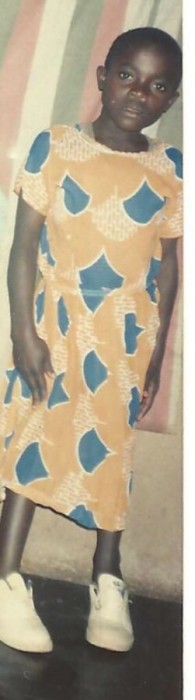
Ruth as a Child
Even though Ruth went to a special school, she was still fortunate. Only 2% of all Cameroonians with disability receive formal education.
Why is that?
There are variety of factors, and I will explain them. I would like to first explain what kind of disabilities exist and what are the causes in Cameroon.
Mobility impairment, blindness, deafness, epilepsy, cerebral palsy, HIV/AIDS, and cardiovascular disease are examples of disabilities that exist. Some of many causes are genetics, postnatal complications, accidents including falls from palm trees, polio, malaria and meningitis. Living with a disability is actually a serious health issue as there is very high death rate among children with disabilities. A study has shown that the disabilities of Cameroonians are exacerbated by the restricted environment. That will lead us to the discussion why so few with disabilities attend school.
Many roads are not paved and muddy. The terrains are hilly and in many regions, it’s mountainous. This means that those with mobility impairments face the challenge of moving their body on these landscapes.
As a result, for those with mobility impairment, the face the challenge of getting to places and going to the bathroom.
For those with hearing loss, they face the difficulty of hearing well in a classroom or lecture hall due to noises coming through windows that have no glass and lack of facilities such as microphone system. Also, for people who are deaf and communicate in sign language have to have an interpreter or go to a school for the deaf. Cochlear implants do not exist.
People with disabilities face stigmatization. Most people with disabilities don’t go to school because their parents think that it’s a bad investment and they will never be able to work. Parents think they can’t contribute to the society.
Aside from the problems with education, people who have mobility disability have difficulties going to markets due to bad streets. Even if taxis exist in the town, many chauffeurs will not give them a ride. As a result, they have to go to markets that are the closest to home and food are sometimes more expensive.
My primary assignment as a Peace Corps Volunteer in Bamenda is to work with people with disabilities in the Northwest region. Ruth with whom I was in touch through Mobility International USA prior to coming to Cameroon is my counterpart. A counterpart is a work partner, community host, “security guard” and support person. Since I got to know her in person for the first time last week, I have been in awe by how she does not let anything stop her. In spite of using crutches, she gets around the country very well and moves a lot. She came to Ebolowa for a workshop that I unfortunately missed due to being sick and in Yaounde. She even rides motos! She’s always so cheerful and outgoing. For the next two years, she and I will be working together along with a totally blind man named, Samuel, who is my work supervisor and president of Coordination Unit of Association of Persons with Disabilities, to help improve the lives of people with disabilities. Samuel inspires me because he is so independent and truly moves so freely with the white cane that I couldn’t believe him when he said that he can’t see a single thing. I asked him if he can tell the difference between light and dark and he said, “No. I see absolutely nothing” He’s 100% blind. He’s a father of five boys. I told him, “You give me the confidence knowing that if a cure for vision loss never becomes available and if I do have to live being completely blind, I can still be independent.”
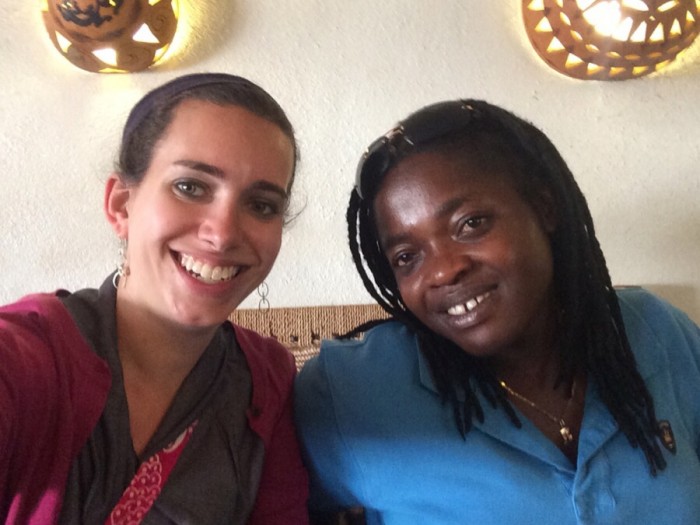
Me and Ruth, my counterpart
The work is going to be very challenging but I’m going to focus on helping one person at time. Ruth said to me today, “Do you know why you have an office with a desk and chair?”
“Why?” I asked. I should note that I did ask Ruth and Samuel when they first showed my office to me two days ago if I’m going to be spending most of my time out interacting with people in communities because I did not come to Africa to sit at the desk all day, especially since the main reason I left my previous job was because I no longer wanted to be at the desk eight hours a day, five days a week.
“Because when you are in the office from time to time, people with disabilities will come to you and ask you to solve all their problems and make their life better.”
“I’m not a fairy with a magic wand,” I said, “But I can educate them on what resources are already available in Cameroon if they are not aware of them and share advice based on my personal experiences.”
Ruth and Samuel have already proved to me in the past two days that I will be really moving around a lot as I’ve already visited one village just outside of Bamenda for a meeting about organizing International Day of Persons with Disabilities yesterday and attended another meeting also about the International Day of Persons with Disabilities today in a different beautiful area of the city. They both told me that I will eventually be doing a lot of traveling throughout Northwest to meet people with disabilities to assess their needs. I’m already very excited about the work!
November 25th, 2014 by Rachel | Tags: Peace Corps | 1 Comment »
And when you’re alone there’s a very good chance
you’ll meet things that scare you right out of your pants
There are some, down the road between hither and youn,
that can scare you so much you won’t want to go on.Dr. Seuss, from the book, Oh, the Great Places You’ll Go!
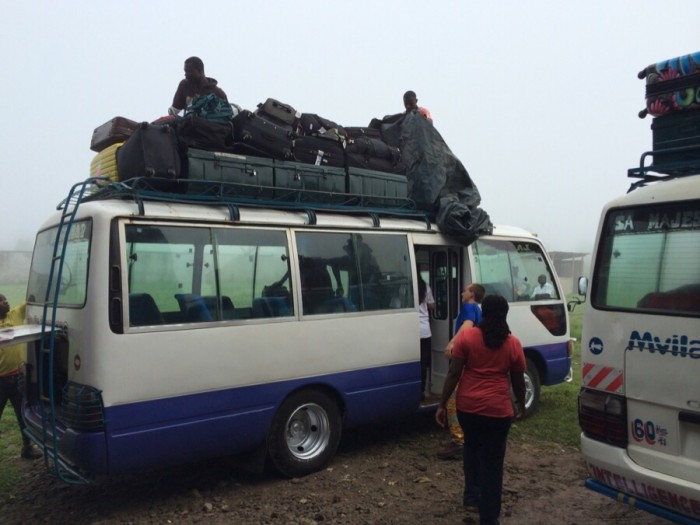
One of the two vans headed for Northwest is being packed up.
After nine weeks of having our hands being held by wonderful Peace Corps staff members, host families and trainees, we, all newly sworn in volunteers, were suddenly released into another new world of unknowns that would be full of scary new challenges. On a very early morning, the day after swearing in, we packed the vans with our suitcases and trunks by placing them on top of the van. Coach buses are almost non-existent, meaning that there is almost no such a thing as putting suitcases in the bottom compartment. In Cameroon, we put suitcases on top of the vans, and we put a rope around it to keep them from falling off.
Sixteen new volunteers including myself and three Peace Corps staff members who were from Bamenda were the first group to take off. We all said farewells to other newly sworn in volunteers and trainers. Then, two vans headed for a very long journey to Northwest.
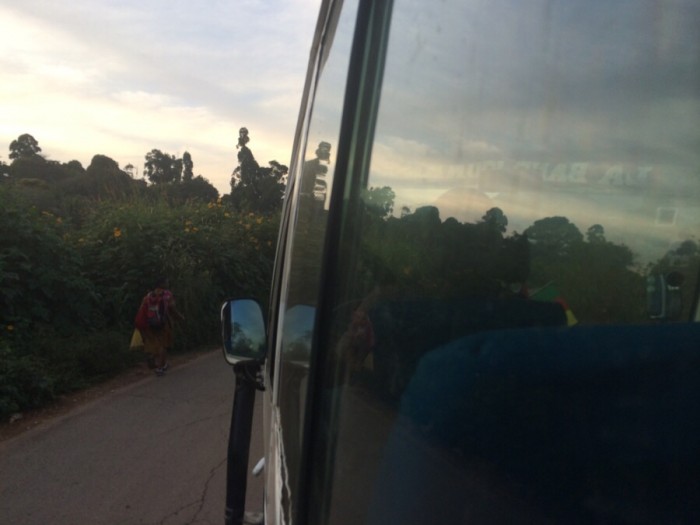
The drive from Ebolowa to Bamenda, the capital of Northwest, took nearly 12 hours. Most of the road was very newly and well paved thanks to Chinese and Brazilians who did the work so that they can obtain natural resources in Cameroon (This is a very good and fair trade according to some Cameroonians who have discussed this situation with me). However, the road from Baufoussam, the capital of West, to Bamenda was severely destructed. The road was paved, but there were so many potholes and cracks. It looked like as if the road had not been repaved in decades. Therefore the drive between Baufoussam and Bamenda took three hours even though it should take only one hour if the road had been paved well. I’ve been told by many people that they expect that road to be repaved in the next two years. On the upside, the drive was scenic as there were many mountains along the way.
Once I arrived in Bamenda, I went straight to a restaurant in a hotel for dinner with a postmate, a new health volunteer who also happens to be placed in Bamenda too, and her counterpart. We then headed to our apartments. My apartment was completely empty. No bed. No stove. No refrigerator. But there was running water, flushable toilet and electricity. It’s important to note that hot water doesn’t exist and will only exist if I choose to buy a heater. I slept on the hard floor in a sleeping bag that I was so grateful to have brought with me from the US and a pillow that my mom sent me in a care package. I could have slept in a hotel for a night with other new volunteers who were going to be continuing to travel to their posts within the next day or two, but I wanted to get started on settling in the new place.
While I feel so fortunate to live in an apartment that includes running water and electricity, I found that I wasn’t satisfied with the location due to security reasons and being far from my workplace. I also found the apartment to be too small. It’s so small that I feel like I’m living in New York City. I spoke with Peace Corps, and they were so understanding that they are already moving forward in finding a new bigger apartment for me in a better location. This means that I’m holding off in purchasing furniture for the living room until I move again in hopefully a couple months.
The following two days, I spent most of my time doing errands which included banking, buying a mattress, pillows, blanket, and kitchen supplies including a stove. The Peace Corps nurse who works only with trainees and came with us to Bamenda as she’s from there, loaned me a beautiful bed to use for two years.
I also finally met my counterpart, Ruth, in person for the first time. I will tell more about Ruth in another blog post, but it is important to mention that she has been a wonderful help in showing me and the new health volunteer postmate around in Bamenda and finding all the items I needed for the apartment.
Opening up a bank account was a frustrating experience as it took four days and several trips back to the bank. It reminded me that patience is a very important trait to have during my Peace Corps service.
As I learned to navigate in Bamenda, I finally realized that street names are nonexistent in Cameroon except for some major roads in the cities. If I got lost, I couldn’t just go to someone and say, “How can I find this address?” I couldn’t use a GPS. Walking around in the city with an iPhone was highly unadvisable as it would make me more prone to security threats. Maps didn’t exist. I had to force myself to work harder in capturing the visual images of my surrounding to remember well my way around. I had to look for points of interests to remember where I should pass by to know that I was heading in the right direction. A couple days ago, when I was walking back to my apartment on my own for the first time from the market, I got lost. I knew I was going in the right direction, but I was just not finding where my apartment was exactly located. I called my health postmate who lives in the same apartment complex as me but her phone was off. So, I called my counterpart, Ruth, and she immediately said, “I’m coming over!” Within two minutes, she was there and helped me learn my mistake and how I got lost. I had to go back out an hour later on my own to try to get a new SIM card for internet, and I found my way around on my own and successfully got back to my apartment on my own. In spite of having experienced a misstep, I have also accomplished in learning how to navigate the city on my own within a short period of time. In the past couple days, I’ve been able to get to and from my workplace on my own and also to other places such as the main city market and Peace Corps office.
I’m not going to deny that the past few days have been very challenging. I felt like as if I had just travelled from another country across an ocean and gotten off the plane in a very strange land. I felt like I was experiencing jet lag all over again and cultural shocks for the first time in Cameroon. I felt overwhelmed and exhausted. I was so overwhelmed that I cried for a minute in front of Ruth. I told her, “I’ll be OK. I know things are going to get better. I just need to get pass the next few weeks, especially the first week.” Alex called me last night shortly after I ate several Trader Joe’s chocolate chip cookies sent by my mother and talking to him greatly helped me figure out how to push through the barriers and realize that I wasn’t the only one facing challenges. I also talked to another new volunteer who is from the agribusiness sector who also happened to be posted in Bamenda too a couple nights ago at a restaurant and talking to her made realize that I wasn’t alone as she was facing very similar difficulties too. I also heard that other new volunteers were facing similar situations too.
I was fully realizing for the first time how lucky I was to be surrounded by so many people who held my hands in Mengong and Ebololwa. I didn’t have to worry about finding my around in the village because I was always accompanied by my host family and plus, there were only two major roads. I still didn’t have to worry about finding my way around in Ebolowa, which was a city, because I was accompanied by the Peace Corps staff members and trainees. I came home to delicious cooked meals every night and always had delicious breakfast ready to be eaten when I woke up in the mornings.
There is so much more that I’d love to share about Bamenda but I will leave this post as it is for now, as I wanted this post to focus on adjusting to the new life and challenges of getting to know a new place. In the following days, I will share the charms that I have found in Bamenda and more about what I will exactly be doing at work.
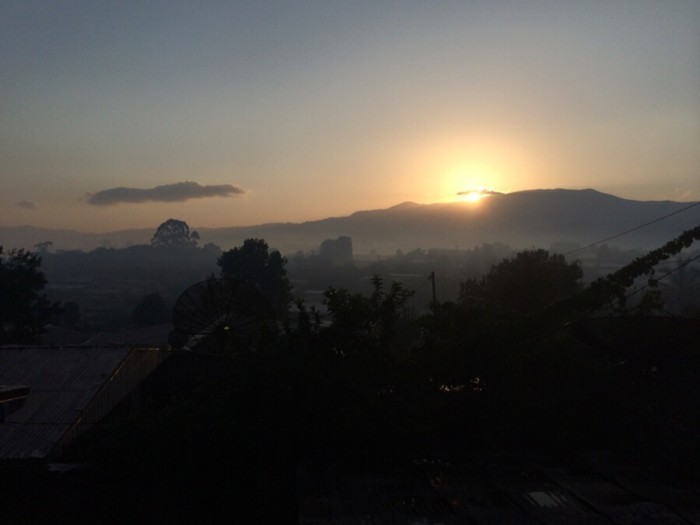
Sunrise from the window of my apartment.
November 23rd, 2014 by Rachel | Tags: Peace Corps | 1 Comment »
“Somewhere over the rainbow, skies are blue, and the dreams that you dare to dream really do come true.”
– Wizard of Oz
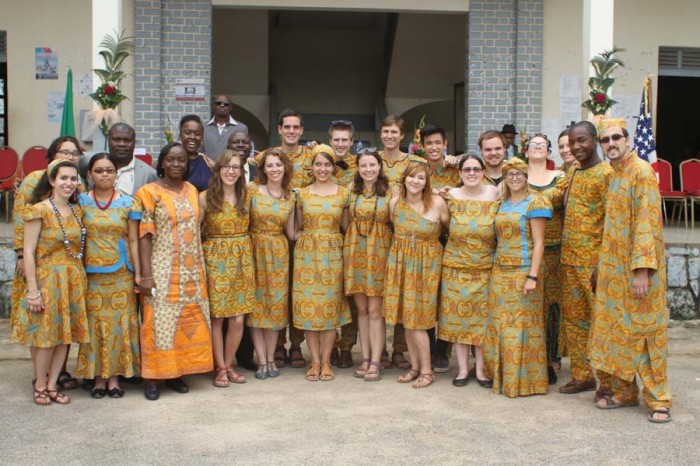
Newly sworn-in health volunteers gathered for a picture
Just when I have finally felt Mengong has truly become my home, and I have fully adapted to the life of living with my host family in the South region and intensive training, all of this has come to an end this past Thursday, November 19th when we all, trainees, swore in to officially become Peace Corps Volunteers. The Country Director, Mark Orlic, Ambassador Hoza and the Governor of South region were present at the ceremony. All of us, former trainees, wore the same beautiful African pagne but in different designs that we had our tailors make. We had a lunch party which included dancing right after the swearing in. Our host families were present during the entire ceremony. My host mother dressed so beautifully that she looked like she was ready to go to a black-tie party.
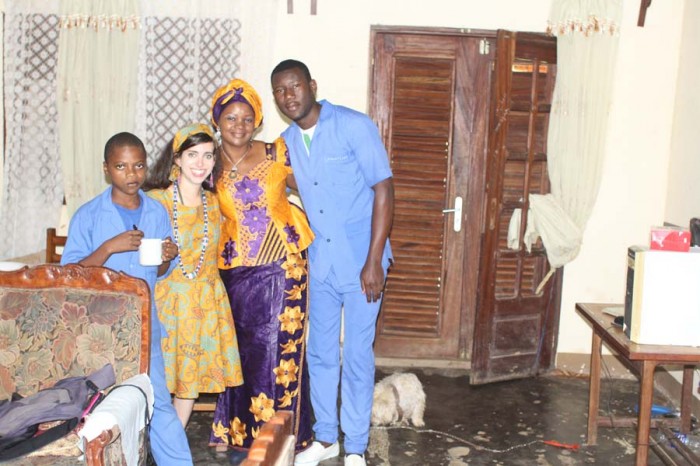
Me with my host brothers and mother
It was a very emotional day. There were so much happiness as my dream was finally becoming true. I was about to begin a work assignment that I will truly love doing.
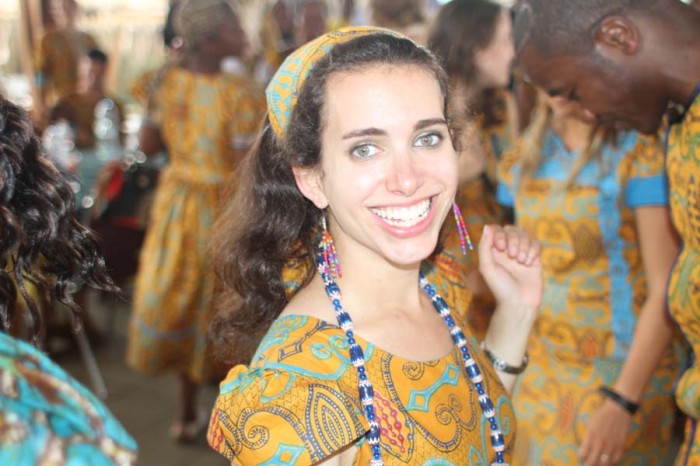
There were also sadness. I had to say goodbye to my host family, to whom I’ve become very close. They were my best guidance and my rock. Before I arrived in Cameroon, I was very nervous. I asked myself, “Will Cameroonians be nice. Will I like the life of Cameroonians? Will life be difficult?” Right after having arrived at my host family home’s for the first time, they showed me that life in Cameroon is truly beautiful. They taught me well the culture and how to love their country. We had wonderful conversations about cultural differences at dinner and when we hung out in the living room. I learned so much from them. They were incredibly patient when I worked on regaining my French fluency. Before I arrived in Cameroon, I thought I was going to absolutely hate the food, but they showed me that I was totally wrong. They introduced me to koke, beignets, spaghetti omelette, fish with rice and potatoes and sheep with green beans, carrots and plaintains. They taught me how to cook some of the meals. They also taught me how to do laundry in the Cameroonian way. They helped me get water from the pump. They also took care of me when I was sick.
My host family has claimed many times that they will come visit me in Bamenda. I will not believe them until they arrive there.
I also had to say goodbye to my dear friend, Mary Beth, who had to go home to the States due to medical separation. It hit me harder than I thought. A few hours after the ceremony, at the big training center, I sat down on the chair and told another newly sworn in volunteer with whom I’ve also become close friends, Alex, “I’m in a slump. I’m not in a mood to party.” I broke down in tears and said “I miss Mary Beth. I don’t want to see her go.” Alex gave me a big hug and comforted me. He reminded me that my other close friends were still here and that most of them were coming with me to Northwest. We then took a moto with a couple other new volunteers to a very fancy hotel where most of us newly sworn in volunteers stayed for the night. Alex and I spent a couple hours outside by the pool discussing the ups and downs we faced in training and what will we will have to face at our new posts.
My counterpart, Ruth, a Cameroonian work partner with whom I’ll be working on daily basis in Bamenda, texted me and said, “I know you’ll miss your family in the South, but you have a family waiting for you in Bamenda.”
November 17th, 2014 by Rachel | Tags: Peace Corps | 1 Comment »
I just hit another lowest point in my Peace Corps service. A fellow trainee who became a very close friend is being sent home due to a medical condition. It is very hard for me to deal with the news as I’ve been through many situations in my life where I’ve been told I couldn’t do what I wished to do because of my disabilities and so, I know how she feels.
When I was first told that I was going blind in 2006, I was about to start my first year at an art university, Savannah College of Art and Design, and study filmmaking and graphic design. I aspired to be a filmmaker and artist. One of the first comments I received shortly after I was diagnosed was, “You can switch to being a screenwriter.” That message put me into a downward spiral. I didn’t want to be told that my dreams have to be crushed. I didn’t want to give up what I loved doing all my life. I didn’t want my newly diagnosed medical condition dictate even more what I couldn’t do in my life when I already have hearing loss that has already tried to give me many setbacks throughout my life since birth.
Fighting for my rights to achieve my dreams has never been easy. I’ve been told, “No” too many times in my life because of my disabilities and it does hurt. I was denied admission to a Jewish day school simply because of my hearing loss. I was told I couldn’t travel abroad because of my hearing loss. I was told I couldn’t take French because people thought it would be too difficult for me. I was told I should switch to a liberal arts university because I’m slowly losing vision. I was denied a job opportunity because I can’t drive. Peace Corps did say “no” when I applied to serve five years ago simply because of my disabilities.
In spite of facing many setbacks and being told “no” so many times, there are two words that keep me going strong in my life and ensuring that my dreams do not get crushed. Those words are “determination” and “resilience.” If I strongly feel that I’m capable of achieving my wishes, I will fight for my rights to do what I desire to do.
Even though I was denied an admission to a Jewish day school, I still went onto Sunday School, learned Hebrew and had a Bat Mitzvah. I won my battle to be allowed to travel and have been to 20 countries, many of which I visited solo. I won my right to take French and successfully learned it during all four years of high school. I continued my education at Savannah College of Art and Design by majoring in photography and graduated Summa Cum Laude. I reapplied to join the Peace Corps, got accepted and so far, my service has been going very well.
Even though I still can’t drive, my family at home in the US is working tirelessly around the clock to raise funds for research to find cure for vision loss so that I can drive again one day.
I hope I’ll see a day in my lifetime when no one’s dream will be crushed because of a disability or medical condition. We still have a long way to go in fighting for our rights to do what we desire to do and also creating treatments for all medical conditions that exist in the world. I wish that people could fully realize that the talents and work ethics that people with disabilities and medical conditions can offer, can truly triumph the limitations or pains we face on regular basis. For every person with disability or medical condition we deny, we could be shutting a door to new bright ideas such as innovating new business tools that can help a community become finically more stable, creating new medical interventions that cure illnesses, building educational tools for children in school and creating technologies that improve lives of people.
I told my friend who is being medically separated not to give up by reapplying to Peace Corps later on once she gets her medical condition resolved in the US. I really hope she’ll be given a second chance one day. She has such an incredible work ethic and determination and so much potential to be a star volunteer. She has a strong desire to improve the lives of many people.