December 13th, 2014 by Rachel | Tags: Disability, Peace Corps | No Comments »
Cameroon is a country where modernization can seem so out of sync. Cell phone signal is far more accessible than water. Most people who do not have direct access to water in the home own a cell phone and can talk freely in the rural areas. Many cell phones sold in Cameroon can hold two SIM cards, allowing people to switch services freely. This is a great advantage for when we are in a situation where one service goes down and we can use the other service or when we are in a location where one service doesn’t exist. Internet exists in Cameroon and while smartphones with touch screens including iPhones and Androids do exist in the country, internet access is still not on the par with the United States and many other both developed and developing countries. Internet options are limited. People in Cameroon pay for internet by the number of data or if they don’t want to be limited by the number of data, they can choose the unlimited option or hourly rate where the speed is much slower. Neither options give us the freedom to be able to use video chat as much as we would like to unless we choose to pay exorbitant amount of money for a lot of data.
A few days ago, a news report came out stating that internet access should be a basic human right. I couldn’t agree more. Internet opens the doors to so many opportunities and solves so many global problems. Internet is the doorway to communication, news, education, literacy, books, movies, socialization, entrepreneurship, video conferencing, shopping, and cultural exchange. According to a news report, Cameroon has unfortunately been ranked the lowest for internet access, meaning that the internet access in the country is less free and more unequal. This news is highly disturbing, especially for those in the disability community. Last week, Hilda, Ruth and I spoke on the radio about how technology, specifically internet, can positively impact people with disability. So, I will discuss here about how internet has broken many barriers for people with disability and how this one technology can single-handedly change so many lives in Cameroon for the better.
If I had to choose one subgroup of people with disability that has benefitted the most from internet, it would be the deaf community. For decades, before the advent of internet, deaf people had limited access to information and long distance communication. During the days when radio was the most popular form of sharing information, deaf people were left out of hearing the news and political debates. Telephone was completely out of reach and this meant that deaf people had to wait for at least a few days for a response from their family and friends through snail mail. Now today, deaf people who do not have cochlear implants or do not hear well enough to converse on the phone can communicate with long distant family and friends instantly through instant messaging and video chats, which are provided through the internet. Social media such as Facebook and Twitter has allowed them to share their voice with a large audience with ease, which was once difficult for them to do. For instance, attending town hall meetings may have once been difficult for deaf people as they would have had to find an interpreter to attend with them. However, they can now connect with their local political representatives instantly through social media by posting a comment on Facebook or sending out a tweet to a political representative.
Internet has without any doubts made the life easier for people with mobility disability and those who cannot drive. They no longer have to stress about spending time commuting to stores, finding a handicap parking space and trying to carry items in the store and to the car. They can purchase items with a click of a mouse and then find the items at their doorstep a few days later. It’s important to note that online shopping would only work if Cameroon first improves the street map by giving more street names and every home an address.
Written news and books are more accessible than ever to visually impaired people. They no longer have to wait for the braille version or never be left out of reading news. When they go to an online news site, they can just click on “Text to Speech” and have the computer read the text to them. This is the same for books downloaded from the internet.
Because only 2% of all Cameroonians with disability receive formal education, literacy rate in the disability community is likely to be very low. When people with disability have access to internet, they could likely become more literate as most of the time spent on the internet involves reading and writing. Most information found on the internet is free. Moreover, there are many websites offering free lessons such as math problems to practice solving, free language courses to learn a new language, and free video clips on science lectures. Therefore, those who do not or have not had the opportunity to go to school can still acquire free education through internet.
Most importantly, people with disability can connect with other people with disability through Facebook groups catered to people with disability and other websites offering message boards and mailing lists and share their experiences, tips and obstacles relating to living with disability and ask questions about an issue they face and learn from others about how they handled the issues. They can also learn information that they would have not otherwise learned from a medical specialist in their country. Plus, since many don’t have access to medical specialists, internet can allow them to acquire information that they would have obtained from medical specialists such as information on assistive devices and rehabilitation tools.
Next week Sunday, I will be helping Ruth and Hilda train a group of women with disability on how to use computers and how to teach other women with disability to use computers. We hope that by educating women with disability on how to use the computer and internet, they will fully realize how much of their barriers can be broken down.
December 9th, 2014 by Rachel | Tags: Food, Peace Corps | No Comments »
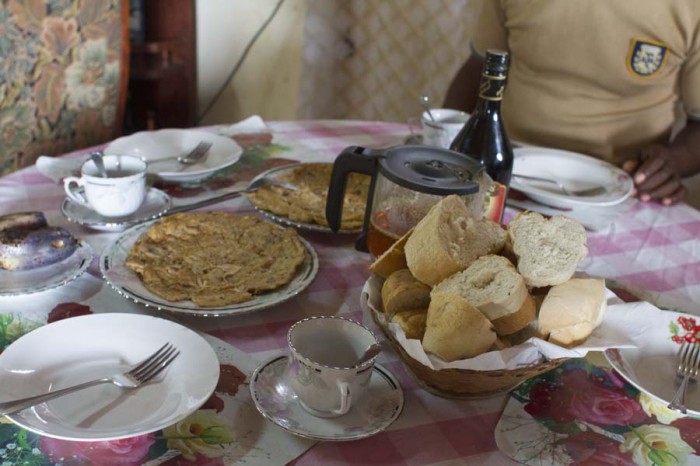
A Peace Corps Medical Officer who has been working for Peace Corps Cameroon for the past more than 20 years said to the trainees, “If you are in Cameroon, you are blessed with food because you have variety of food.” She is certainly right. Cameroon has a wide variety of dishes due to colonization, learning techniques from Europeans, and geographical influences. Within the first week after arriving in Cameroon, my host family fed me beignets, spaghetti omelette, fish with peanut sauce, bread with chocolate spread, sheep with carrots, green beans and fried plantains, avocados, and spaghetti with vegetables.

Beignets
Breakfast in Cameroon can be either simple which means just beignets or bread with chocolate spread or a dinner-style meal such meat with vegetables or salad. Beignets are like donuts and come in variety of types which includes plain beignets with crispy crust and beignets with soft crust and sugar coating. They are traditionally made with palm oil, the most commonly used type of oil in Cameroon. Cameroonians in fact make almost all of their dishes with palm oil. Cameroonians also often eat beignets with beans. The chocolate spread that is used to put on bread is similar to Nutella, the spread that Americans and Europeans both love. The difference is that the chocolate spread that is primarily used in Cameroon is mixed with peanuts instead of hazelnut, and it still tastes incredibly delicious. Children in fact will often have bread with the chocolate spread for lunch or snack after school in addition to breakfast. From my observation, I noticed that many Cameroonians also love eating bread with just mayonnaise too for breakfast, lunch or snack, which can seem strange to many Americans as we normally eat mayonnaise only with other ingredients that is included in the bread such as vegetables, meat and cheese.
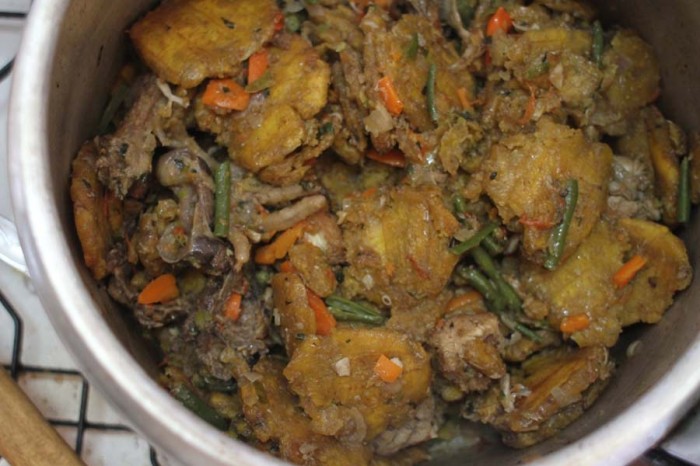
Chicken with fried plantains, green beans and carrots
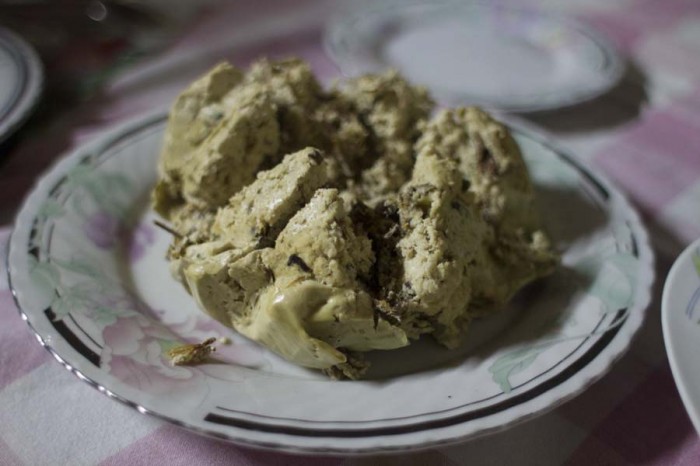
Pistachio Flan
Lunch is usually very simple and light for many Cameroonians. From what I’ve observed, most eat bread with chocolate spread, mayonnaise or butter or a bag of peanuts.
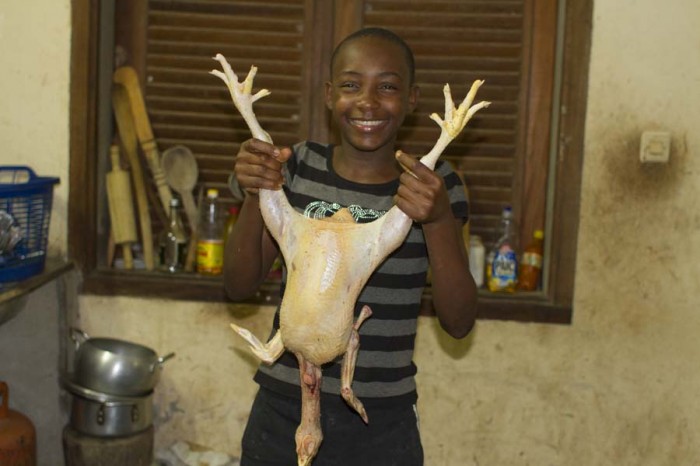
My host sister proudly shows off a chicken that was just killed by my older host brother
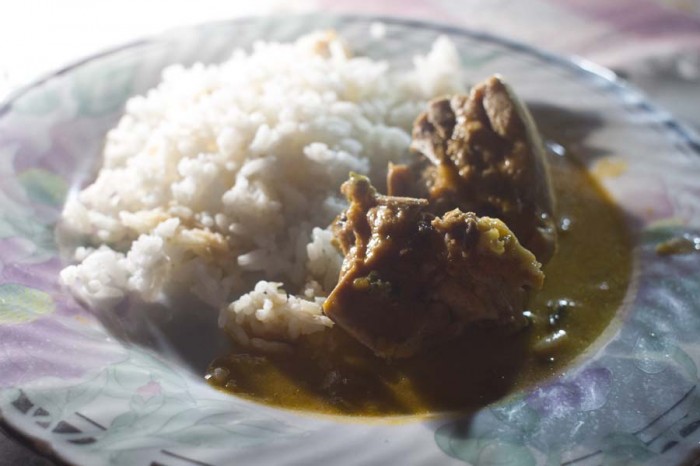
Chicken with hot red pepper sauce and rice
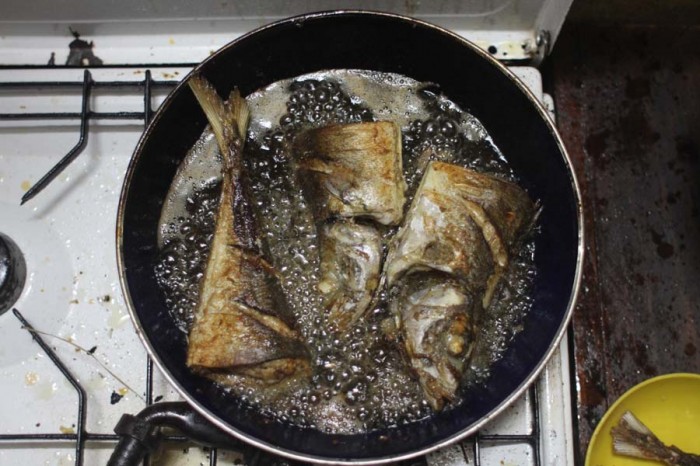
Fried Fish
Dinner is where one can realize that Cameroonians make a wide variety of dishes. Meat and fish are huge staples in Cameroon. It is common to find people eating fish at least a few times a week, especially in the Grand South region. Fish is usually fried with palm oil or grilled and is often served with rice, cassava or potatoes. Sometimes it includes sauce such as peanut sauce or tomato sauce. Beef is commonly found on people’s plates, especially in the Grand North region where cows are commonly found. Like fish, it is often fried with palm oil or gilled and served with vegetables, cassava or rice and sauces. Chicken is also quite common. In fact, many Cameroonians like my host family kill chicken on their own and make their own fresh chicken. Bush meat such as snakes and antelopes are very common. Cameroonians are usually quite proud when they catch a bush meat. Beans are also often served. One of the most unique and traditional Cameroonian dish made with beans is Koke. This dish that is originally from the West regions is made with beans and hot red pepper grind up and mixed with palm oil. It’s cooked in a leaf over a fire like as if it’s cooked in an oven. It tastes like a flan and the flavor is very rich and delicious. Speaking of hot red peppers, hot red peppers are frequently found in many of Cameroonian dishes. While many Cameroonians may not find hot red peppers not to taste so spicy, it may taste too spicy for Americans’ taste bud. Yams and plantains with peanut cream is another common dish. Peanut cream which one can say that is exactly like peanut butter as it’s grounded peanuts, but it tastes different from the peanut butter we eat in the United States. It’s likely due to the fact that we add sugar to the peanut butter and peanut flavor is also different. Pistachio is also commonly found in Cameroon and used in many dishes. An example would be a pistachio flan which is very similar to Koke.
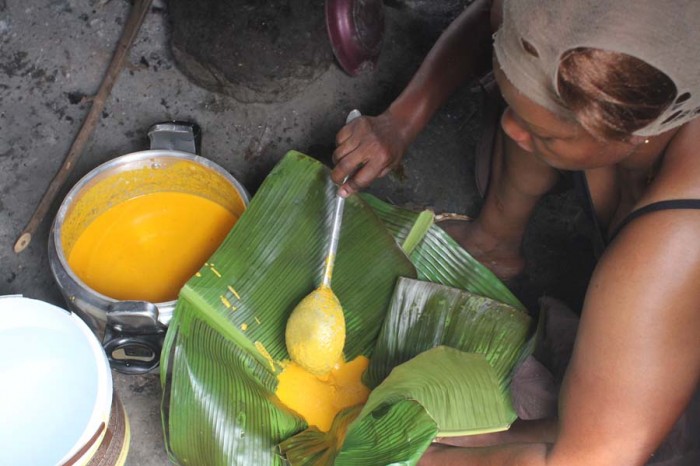
My host mother is making a koke
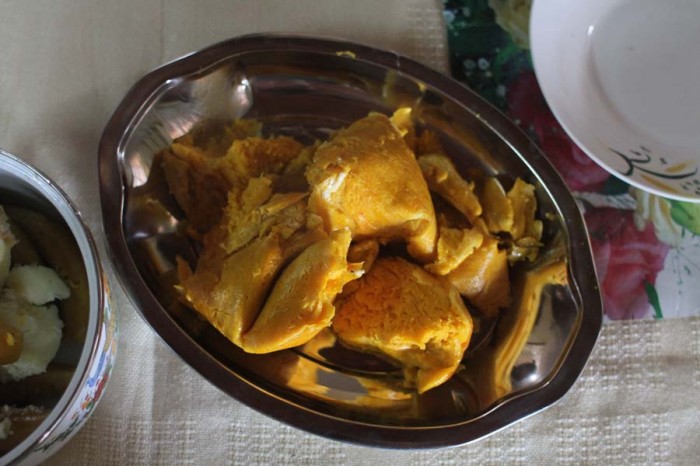
Koke
Bâton de Manioc, also known as Bobolo, is a food that is well-loved by many Cameroonians and is often found on the roads sold by locals. I do have to unfortunately admit that many Americans including myself are not crazy about this food as it can taste a little bitter. It looks like a stick wrapped up by a leaf. Inside the leaf is ground cassava. The purpose of using a leaf is to give the ground cassava some flavor. It’s eaten throughout the day, be it lunch, dinner or snack.
Fruits are plentiful in Cameroon which includes pineapples, bananas, papayas, grapefruits and oranges. In fact, oranges are green in Cameroon!
There is also French influence in Cameroon as boulangeries are found in major cities. When walking into a boulangerie, it does feel like being in any bakery found in France. It boasts a wide variety of fresh bread including whole wheat bread and milk bread, different types of croissants including pain au chocolat, and cakes. Some boulangeries may also have quiche and focaccia. Cheese are also often found in boulangeries but are usually very expensive. Cheese is incredibly rare and almost non-existent in Cameroonian dishes. While boulangeries are primarily found in major cities, French bread and milk bread can still be found in local shops in villages.
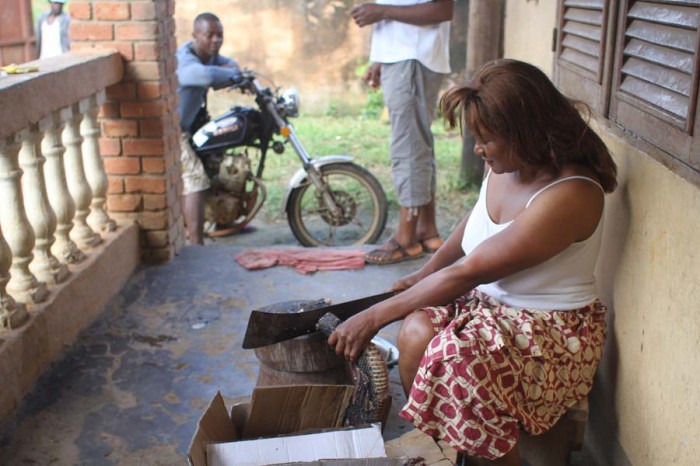
My host mothers prepares a bush meat, snake.
December 3rd, 2014 by Rachel | Tags: Peace Corps | 3 Comments »
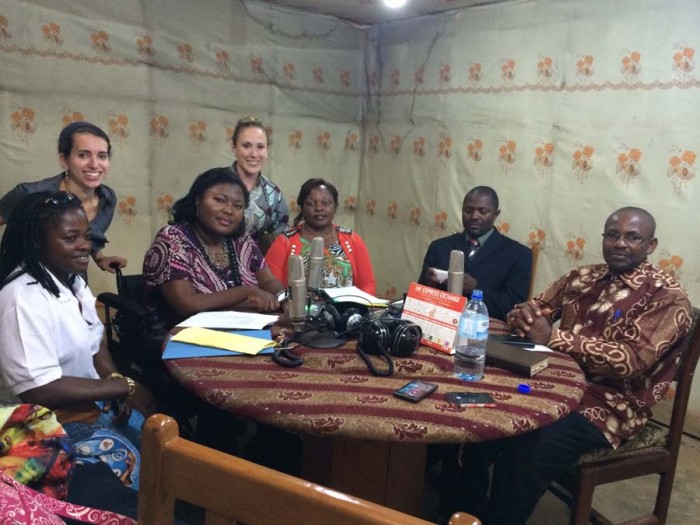
Me at the radio talk show with Ruth, Hilda and other guests
Last Friday, Ruth, my counterpart, took me to her weekly radio show on people with disability that she does every Friday with Hilda Bih, a Cameroonian woman with disability who was a 2014 Mandela Washington Fellow. I went there only to observe. However, Hilda pulled me in and asked me a few questions about my growing up with hearing loss, cochlear implants and accessibility for people with disabilities in the United States. Talking on the radio to the audience in Bamenda was an opportunity for me to accomplish Peace Corps’s second goal which is to help countries outside of the United States understand the American culture. I created awareness about how people with disability, especially those with hearing loss, live in the United States.
The most compelling question Hilda asked me was “Tell us what your life would have been like if you were born in Cameroon as a person with disability?” Based on my research and observation, I most definitely would not have received a cochlear implant and be able to hear and speak because even 25 years after I first received the technology in 1989, cochlear implants still do not exist in Cameroon today. Even if I could obtain hearing aids, they still would not work at all as I am totally 100% deaf without the cochlear implants. In order for hearing aids to work, one has to have residual hearing. Like almost all deaf children in Cameroon, I would have gone to a school for the deaf where I would be learning to communicate in sign language instead of going to a regular school with the same children in the neighborhood. There is a chance that my parents would have known only some basic signs at the most or not have learned sign language because most parents in Cameroon do not take the time to learn sign language due to the difficulty of mastering a knowledge of another language later in life and lack of time to learn it, as they need to spend time working and caring for the family. I would certainly face the challenge of communicating with the extended family as all would most likely not learn sign language too. My social life outside of school would have been limited as just about all children in the neighborhood would most likely not know sign language to be able to communicate with me. The level of my language skills would probably have been low, especially if my parents did not communicate in sign language at home with me, and I did not start attending the school for the deaf until past the critical language development years which is newborn until three years old. I would most likely struggle to be employed or never employed. I would most definitely be facing isolation and far more barriers in communication because 99 percent of the people surrounding me do not know sign language. I also would not be able to hear and enjoy music.
My cochlear implants have broken the barriers and opened the doors for me as I am able to communicate with ease with everyone surrounding me through hearing and speaking, has allowed me to go to the same school as other children in my neighborhood and be in the same classroom with them and without an interpreter, socialize with them outside after school and on the weekends, and most importantly, gain employment.
Hilda also asked me, “How do you and Americans view yourselves as persons with disability?” My response was that many Americans do not allow disability to define who we are. When growing up, I always saw my cochlear implant devices like as if they were glasses. They are just an accessory that allows me to hear like people who have glasses to correct their vision issues. When I was growing up, I always saw myself as a person who was just like any other human beings but just happened to be born deaf. That’s not how many Cameroonians view themselves as people with disability. Many view themselves as if they’re totally different from humans without any disability. Hilda said that when she was a child and even though she went to a mainstream school, she often wished that she would go to a special school so that she could be with other children who were “just like her.” It’s important to note that this is just a generalization and does not represent every one of the Americans and Cameroonians, especially since there are still some Americans with disability who do view themselves as totally different from other human beings.
December 2nd, 2014 by Rachel | Tags: Peace Corps | No Comments »
• Dry season is underway in Cameroon, and I can’t decide which season I prefer, dry or rainy. In Cameroon, we have only two seasons, dry and rainy. Rainy season clearly means lots of rain and cloudy days. It certainly also means cooler temperatures. While dry season of course means lots of sunny days but it also means lots of dust. During dry season, we never have to worry about the unpaved roads being muddy, slipping and falling, and getting our feet dirty. Most importantly, we don’t have to worry about muddy water being splashed onto our clothes by motos passing by us. However, during the dry season, we still get dirty. The unpaved roads are so dusty that with the winds, the dust can get onto our clothes. Plus, during dry season, I see lots of tiny little bugs crawling on the floor. I’m thankful for the bed bug spray I brought with me to kill them.
• There is no such a thing as personal space. When taking taxis in Bamenda, I do not have a taxi to myself unless I pay extra money. On top of that, the taxis do not always take me from point A to point B unless I choose to pay a large amount of extra money. Also, if I want a taxi to come directly to my apartment to pick me up, I have to call a taxi driver. The way the taxis work in Bamenda is that it primarily drives on the major streets, and it picks up people along the way who want to go in the same direction that the taxi is going. So, here’s an example, I walk about three minutes from my apartment to the closest major road. Let’s say I want to go to a restaurant inside the International Hotel. It’s not on a major road. The closest major road is Commercial Avenue. I walk across the road because most taxis on the other side of the road is heading towards the center of the city where Commercial Avenue is located. I flag a taxi, and one stops, I tell the taxi that I want to go to Commercial Avenue. The taxi just takes off. That means that taxi is not going in that direction. I flag another taxi and this time, that taxi is going to Commercial Avenue. I get in. There is already a person in the taxi. A couple minutes later, the taxi stops and catches another person who is going in the direction that the taxi is going. That person gets in. The cycle can repeat until the entire car is full. The definition of a full car is when there are three people in the back and two people in the passenger front seat and plus, the driver. Once the taxi arrives at Commercial Avenue, I get out. Then I walk a couple minutes to the restaurant. It’s almost like taking a packed subway ride in some way. The only modes of public transportation that exist in Bamenda are taxis and motos. Taking a moto is a better option if I want to go from point A to point B without paying a huge extra amount of money and not be squashed in the taxi. However, I have to carry a helmet around which is not always convenient.
• “I see a Peace Corps Volunteer!” My counterpart called out while we were in a taxi the other day. She then said that she knew it was a Peace Corps volunteer because she was wearing a helmet while riding the moto. We, Peace Corps Volunteers, are likely the only ones who wear helmets while riding the motos in Cameroon.
• Getting internet figured out has been a nightmare. I first purchased 2GB of internet from Nexttel, a cellphone company, on SIM card and turned my iPhone into a wifi station. It was the best internet connection I’ve ever had. The speed was fast as it was on 3G network. However, I used up all 2GB in 24 hours. I switched to MTN with unlimited internet as it was cheaper than 5GB of internet from Nexttel, the biggest plan the company offered, except it was much slower. However, it was too slow, and it often went down. After talking to other Peace Corps Volunteers, I learned that getting an internet key from Camtel, a Cameroonian internet company, with 100 hours of internet was the best option. I was told that it was still slow but not as slow as MTN. I got an internet key from a very friendly gentleman with mobility disability who works for Camtel but it wouldn’t work on my Mac computer. It turned out that the key was defective as it didn’t have the Mac version of the software installed on the internet key. I went back to the gentleman, and he gave me a new USB key. It still didn’t work. I went back to the gentleman again, and he went all over the city looking for a key that would work on my Mac computer. He finally found one, and I’m now typing up this blog from the Camtel internet key. The connection is still slow but it’s fast enough for me to at least read. Therefore, I’m satisfied. I just want to at least be able to use e-mails and social medias, read news, download eBooks and blog. According to my counterpart, Cameroon should have better internet options by the end of 2015. Every person’s phone number in Cameroon was changed recently by adding 6 in the front of the number, and I was told the reason was because it would help improve the internet system in Cameroon. I hope this will be true because it would be nice to be able to do video chats with my family and friends.
• I bought a custom made mosquito net holder made of bamboo. The bamboo shop gave me a set of cut up bamboos and nails and directions on how to put it together. I put it together by myself, and it was a nightmare. It was like building an Ikea furniture, meaning that the directions were unclear, and keeping all the parts attached was difficult. Once I finally just almost got it put together, it collapsed. I took all the bamboos back to the shop. I created a new design myself that should be more sturdy and not require me to build at all, but I have to wait until I can meet with the owner of the shop to see if my design can work. For the time being, I have the mosquito net attached to the curtain rods next to my bed, and then the net hangs over my bed like a half triangle. I can only sleep all the way on the end next to the curtain rods because the net doesn’t touch my face. Making sure I don’t get malaria is far more important than being comfortable while sleeping.
• I miss cheese. I just made pasta with olive oil, tomatoes, garlic, avocado and onions. It didn’t taste good. I think it was because it was missing parmesan cheese. I just had a bag of Cheez-Its thanks to my grandmother who sent it. Cheese is very hard to find in Cameroon, and when it’s found, it’s very expensive as they’re imported from France.
December 1st, 2014 by Rachel | Tags: Peace Corps | No Comments »
Prior to leaving for Cameroon, someone asked me this question, “How is Peace Corps going to ensure you’re safe from sexual assaults especially in a country with a high rate of AIDS?”
When I was asked this question, I was angered and sad to see that there is still so much ignorance about Africa and AIDS. After having been in Cameroon for two and half months and received education on HIV/AIDS in training, I’d like to take an opportunity to educate others about this disease on World AIDS Day which is today.
I would like to first say that life expectancy of many people living with HIV/AIDS now exceeds the average life expectancy of people without HIV/AIDS as long as they receive appropriate treatments and take a good care of themselves.
Treating people with HIV/AIDS has come a long way since the 1980’s when people were dying left and right. Living with HIV/AIDS is no longer a death sentence today. There is a treatment called Antiretroviral Therapy (ART) that treats people living with the disease. This therapy consists of three antiretroviral drugs that help suppress HIV and stop the progression of the disease. If one does get raped, have unprotected sex or get an injection with unclean needle, there is also a drug called Post-Exposure Prophylaxis (PEP) that has 80% success rate of preventing HIV/AIDS from being developed after having been exposed. It must be taken within the first 72 hours after possible exposure to HIV/AIDS in order to greatly reduce the risk of getting HIV/AIDS. The earlier it is taken, the more effective the treatment is. It is readily available to Peace Corps Volunteers.
Only 4.3% of people in Cameroon have HIV/AIDS. The countries in Africa with the highest percentage of people who have HIV/AIDS is in the 20’s percent. This is not to say we should ignore the problem because the percentage may appear lower than what you thought, but it is to acknowledge everyone what is the true percentage of people living with HIV/AIDS. To be honest, 20% is still a huge number and instead of being fearful of going to an environment where there is a large number of people living with HIV/AIDS, I believe that we should encourage people to go to those places and help decrease the number. By refusing to allow people to help, we are keeping the numbers high.
Cameroon has done a lot of work to educate their population about preventing the spread of the disease. I interviewed my host family in Mengong about HIV/AIDS for one of my many training assignments, and I was very thrilled that they had well-rounded knowledge. They understood how to have safe sex and knew that antiretroviral therapy existed. They said that while Cameroonians are very open to talking about the disease, many people living with HIV/AIDS will still not tell others that they have the disease due to stigmatization and fear of being rejected by other people. Therefore, we still have work to do in educating people about accepting others with the disease.
While so much progress has been made in treating and preventing HIV/AIDS, we still have work to do in improving the situation such as creating a vaccine to prevent the disease and educating others about currently available options to treat people with the disease.
Since I was also asked about how Peace Corps handle sexual assaults, I thought I should share about how Peace Corps handle the situation. Peace Corps’ current director, Carrie Hessler-Radelet, was sexually assaulted during her Peace Corps service in the 70’s. Since becoming the director, she has made improving protections against sexual assaults and the quality of care for those who were sexually assaulted her highest priority. From the lectures I have heard from both the medical and security teams during training, I have been impressed so far by how seriously they take in ensuring we are protected from sexual assaults and the high quality services they offer such as counseling and flying victims back to DC with a PCMO to see doctors in DC for those who do unfortunately get sexually assaulted. From what I have gathered in the training sessions, I just simply need to follow the security protocols and beware of my surroundings.
One should keep in mind that one in five women experience attempted or completed sexually assaults on college campuses in the US, which is to say that being in the US is equally dangerous as being in Cameroon. I personally know at least three young females who were raped in college in the US. We have to fully realize that every country has its own share of problems and no country is superior to one other country.