November 17th, 2014 by Rachel | Tags: Peace Corps | 1 Comment »
When you’re in a Slump,
you’re not in for so much fun.
Un-slumnping yourself
is not easily done.Dr. Seuss, from the book, Oh, the Great Places You’ll Go
Two weeks ago, when the training was still going very well and coming close to an end, a bunch of bricks suddenly fell on me. A couple hours after one lunch, I felt stomach pains but continued to go on with my work. Later that afternoon, I hanged out at my host mother’s boutique and talked to my host mother and sisters. All of a sudden, I couldn’t stand, felt queasy, and needed to vomit. Just after I kneeled to the floor outside, my host mother grabbed me and pulled me to a bathroom behind her boutique. After I went to the bathroom, I felt a little better. I went back to the boutique to continue to chat. When one of the trainees came over, I mentioned that I was feeling sick and it had to come from the lunch. Because she lived with the woman who made lunches for trainees and staff members and she saw her making them, she knew the source of cause. She mentioned to me that the cold fresh soy milk I drank at lunch was mixed with unpasteurized cow milk. “Ah! Good to know,” I said and hoped that I was just simply experiencing what people with lactose intolerance experience – just a very short term stomach pain and diarrhea.
As the night went on, I got sicker, couldn’t eat dinner and just stayed in my room and the bathroom. I was going through my first very typical food poisoning experience in Cameroon. I contacted a Peace Corps nurse who guided me on what I should do which included taking a medication that was already provided to me at the beginning of my service and drinking lots of fluids with oral rehydration salts. I got very little sleep that night.
By the next morning, I felt a little better but extremely exhausted. I stayed at my host family’s to rest and missed training. That night, I felt much sicker. I was in tears. My host mother looked at me and said to me, “You need to go to the hospital.” She took my cell phone and called Peace Corps. Peace Corps picked me up promptly and took me to the hospital. I spent the night at the hospital with a Peace Corps nurse who provided me medicines and fluids via IV for severe dehydration.
The next morning, I felt so much better and ready to get back on with my life. I took some lab tests which confirmed that I had an ordinary bacterial infection and was put on antibiotics for three days. About an hour after I went back to my host family feeling very well, I felt very sick again. I was back in the hospital that night with a Peace Corps nurse who spent the night with me again and gave me more medicines and fluids via IV.
The following morning, as I began to feel a little better, I had more lab tests. Shortly after the lab test, the Peace Corps nurse said, “The milk you had was very very bad. You’ve been tested positive for Typhoid Fever.”
That moment gave me flashbacks to my time in Peru in 2009. When I was in Peru and got sick with food poisoning, I went to a hospital and had lab tests done. When a doctor told me I was tested positive for Typhoid Fever, I said to her, “I’ve been vaccinated against it.”
“The vaccine doesn’t always work,” she said.
I just went on with my life in Peru by believing that I only had an ordinary bacterial infection and thought that the doctor had just misinformed me. I always believed that vaccines are 100% full proof.
I was vaccinated for Typhoid Fever in April 2009 and again this past August before coming to Cameroon.
“So the vaccines for Typhoid Fever don’t really work?” I asked the Peace Corps nurse. She went onto to explain to me that no vaccines are 100% full proof against diseases and that they just build up immunity. She said that however, because I had been vaccinated, I had a very low count of Typhoid Fever. I had 2 out of 10, 10 being the most severe. If I had not been vaccinated, I would have had a much higher count and been gravely ill.
The Peace Corps nurse also informed me that Typhoid Fever is typically caused by fresh juices and fresh unpasteurized milk.
The lab test result gave the answer to why I was experiencing the illness the way I did. I felt better the day before because the antibiotics had kicked in for the ordinary bacterial infection and then Typhoid Fever kicked in and the antibiotics struggled at first to fight against both. I was put on antibiotics for 10 days total instead of 3 days to get rid of Typhoid Fever. I stayed at the hospital for additional three nights to be under observation to make sure I was really better even though I was better by the third day.
When I finally went back to my host family, a few hours later, I felt very nauseated again. I contacted the medical team to tell them I was feeling sick again and absolutely frustrated and that this was not right. I spent the night at the training center with a nurse to be under observation and then went to Yaounde the following morning. My stomach began to hurt again during the night. Once I got to Yaounde, I was examined by the medical officers and then put in the hospital overnight for observation. I felt sicker overnight as I was experiencing stomach pains, extreme nausea and also cluster headache for the first time in two years. The medical officers brought me back to the Peace Corps headquarter the following morning to keep me under watch. A medical officer finally gave me a clear answer as to why I’ve been really sick and struggling to recover – I had two different bacterial infections happening at the same time – typhoid fever and salmonella. She explained that I would get better but the recovery would take longer than usual. She provided me additional medicines to help me get through the recovery. I was also told that the antibiotics was the one likely causing the nausea. I redid my entire lab test in Yaounde. It came normal all across the board, meaning the bacteria has been cleared out of my system. So they stopped the antibiotics. Within 24 hours of stopping the antibiotics and starting different medications, I felt so much better and headed back to Mengong.
As I looked back on my time when I got sick in Peru, I realized that the doctor did not misinform me because the pattern of my illness was somewhat similar. I remembered that I had to be on antibiotics for 10 day in Peru instead of the typical three days because I was still not clear after three days. I had fresh orange juice right before I got sick.
I was so grateful and thankful to be surrounded by amazing people who looked after me. A Peace Corps nurse who only works with the trainees spent every night with me in the hospital in Ebolowa and kept in touch with a Peace Corps medical officer in Yaounde who continually checked on me while I was in Ebolowa and also contacted the medical department at the Peace Corps Headquarter in DC to make sure I was taking the best treatment course for my illness. I truly got the best medical care. My host mother called and texted me everyday to check on me. She also even came to visit me in the hospital in Ebolowa and brought me a homemade heart shaped cake. I should note that the hospital was 30 minutes from Mengong where I was living. My host father who was on a business trip in Far North not only texted me everyday to check on me, but also called a Peace Corps staff member to check on me. Two trainees who have become close friends checked on me constantly. Some other trainees visited my host family to get updates. They all truly rallied around me to get better by saying very comforting and positive words such as “stay strong,” “you’ll get through this,” and “you’ll be OK.” Their messages made all the difference in my recovery.
I am sharing this story because I feel that it’s important to inform people that vaccines are not 100% effective. When traveling to countries where exotic diseases exist and if you get sick, you should still get tested for diseases you’ve been vaccinated against.
I’ve also certainly learned that I should only drink milk when it’s in a known brand bottle or boiling hot.
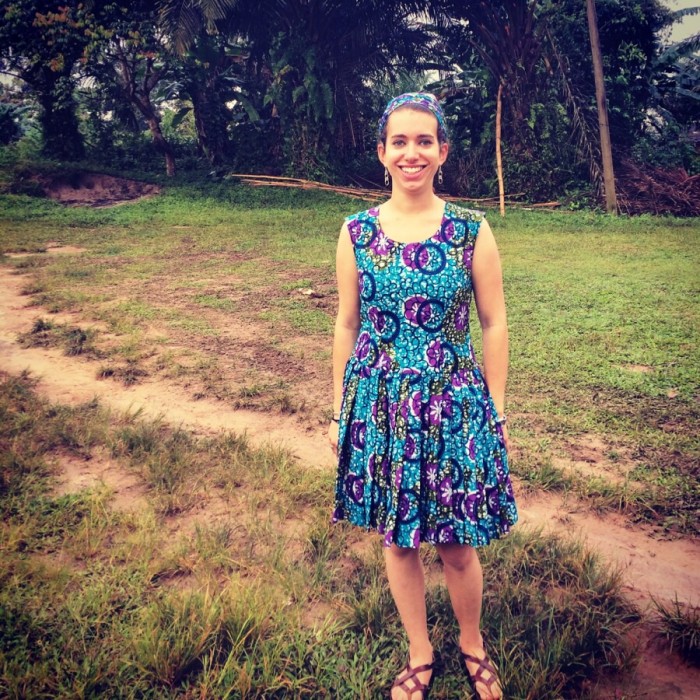
Here’s a photo that was just taken a few days ago of me in my awesome new custom made African pagne dress to show you that I’m alive and back to my old self.
November 14th, 2014 by Rachel | Tags: Peace Corps | No Comments »
• A Returned Peace Corps Volunteer who served in a country in West Africa warned to me prior to leaving for Cameroon that I will be craving for certain American foods that I rarely eat in the US. She’s so right. I’ve had some cravings for a good beef dish. So random! I’ve dreamed of having a good barbecued sliced steak or hamburger. I do still miss cheese though!
• When in the US, I detest soy milk. It tastes so sour. However, in Cameroon, I’ve been addicted to them. When I get cold vanilla soy milk, it tastes like drinking vanilla milkshake from McDonald’s. My host mother started selling them at her boutique, and I don’t think she knew they’d be so popular among the Americans! I’ve been drinking it almost everyday and so have other Peace Corps Trainees. They fly off her shelf quite quickly.
• My host sister asked me if high schools in the US allow students to kiss, hug or show any love for the significant other. I said, “Oh sure! Of course.”
“It’s not allowed here in my high school,” she said.
“Why?” I asked.
“Because they think it will cause more pregnancies.”
“Do you agree with that?”
“No,” my host sister giggled.
“Do you see lots of pregnant students in your school?”
“Oh yes! A ton!”
• I learned why all Cameroonian children, both boys and girls, in Mengong have their hair shaved. It’s a school dress code.
• My host siblings and I had a conversation about teachers slapping students with a stick for getting in trouble. Even though they are all very good students who work and study hard, they still have been slapped many times, primarily for talking in class. They said not all teachers do it though. They didn’t express any disgust for teachers being allowed to slap students and saw it as a normal everyday life. They even giggled when they admitted when they have been slapped too many times to count. I told them that in the US, if teachers slapped students, it’d be seen as an abuse.
• I got another proposal a week ago. Two guys asked me if I’m married. I said, “No.”
“Aw! Why not!” said one guy.
“You should get married,” said another guy.
“We’ll find you a man!” said one guy.
“I will find a man myself one day,” I said. Because I had a lot of things to do, I chose this response to cut off the conversation and allow me to walk away.
• Alcoholism is a serious problem in various parts of Cameroon. There are parents who spend money on buying alcohol to drink and as a result, they do not have money for children’s school fees, uniforms and supplies. I see many children in Mengong who do not have school uniforms. I also encountered a mother breast feeding and drinking at the same time at a bar. Financial hardship is one of the big factors for drinking.
• When there is no power when I wake up, I know the roads will be muddy because the rain has poured during the night. That means I need to wear waterproof shoes. I haven’t checked the weather forecast since arriving here. It’s easy to figure out what clothes to wear for the day. Temperature remains very similar on daily basis but I wear my clothes based on what the roads will be like.
November 2nd, 2014 by Rachel | Tags: Peace Corps | No Comments »
I had my first Cameroonian medical experience a few weeks ago. No, I didn’t have food poisoning. I was experiencing pressuring pain in my right ear. Based on how the pain felt, I knew it was likely due to lots of ear wax and some sitting on a sensitive spot in my ear. However, I wanted to take precautions by checking to make sure there was no infection. So, I went to a hospital in Ebolowa.
Shortly after I sat down with the doctor, I explained to her about the pain in my right ear. She asked me if I was experiencing difficulties in hearing. I told her I have cochlear implants. As expected, she has not heard of them and asked me what they were. I pulled a sound processor off my ear to show it to her and explained what it was. Once she saw it, she understood well that it’s a hearing device for people who are deaf as the device looks similar to a hearing aid.
The doctor pulled out an otoscope and changed the batteries. Once the batteries have been changed, it would not turn on. She took batteries from a clock and put them in the otoscope. It turned on finally. I really appreciated her commitment to get the otoscope to work.
As she examined me, she whispered in my ear and asked me to repeat what she said. I passed the test. I wanted to giggle but I didn’t want to because it was understandable that the doctor didn’t have any background in cochlear implants. To be fair, there are many doctors in the US who have never heard of cochlear implants too. People who hear with cochlear implants do not hear through the ear canal like people who hear normally. They hear through the microphone on the device that that sits behind the ear lobe. No matter how much ear wax we may have or infected the ear may be, it does not determine how well we can hear. The cochlear implant bypasses the outer ear, middle ear and most of the inner ear. The sounds travel through our sound processor and then into the computer chip and electrode array that sits inside our head and sends signal directly to our hearing nerves and brain. This means that no matter what happens in the ear, we, people with cochlear implants, can still hear very well.
The doctor was very patient with me and took time to examine the ear closely. As expected, she saw lots of ear wax and no infection.
I got the ear wax removed by Peace Corps’ own nurse a couple days later. I felt better.
The pain in my right ear came back about two weeks later along with a sore throat. The Peace Corps’ nurse took me back to the same doctor at a hospital in Ebolowa. She examined the ear very carefully and saw absolutely nothing abnormal. The nurse also looked and saw nothing abnormal. We agreed that it was probably just fluid, and I was probably coming down with a cold.
A week later, I still haven’t had a cold but I was still experiencing intermittent sore throat and pain in the right ear. I was feeling something was pressuring inside my right ear. It felt like I wanted to stick my finger inside it.
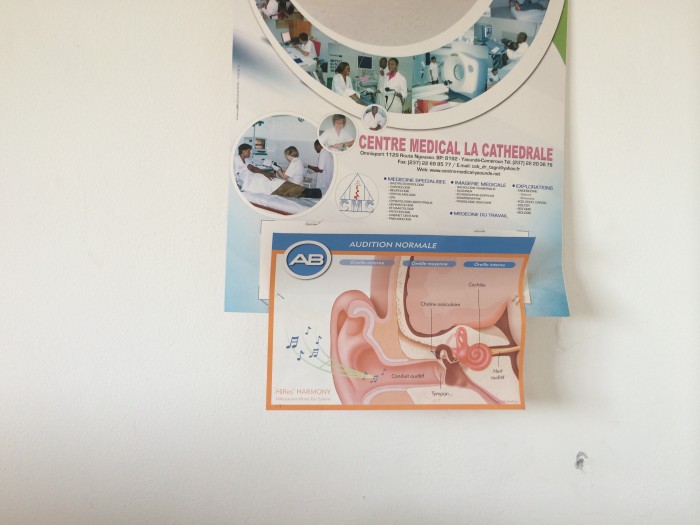
I made a trip to Yaounde to be examined by a Peace Corps medical officer at the headquarter and an ENT at a hospital in Yaounde. The hospital where I went to was very clean and in a very good quality. I had to wait very little time to see the ENT. Once I entered her office, I immediately noticed a poster with an Advanced Bionics logo. As a cochlear implant recipient, I was incredibly excited to see a logo of a cochlear implant manufacturer, Advanced Bionics, in Cameroon. Cochlear implants are not done in Cameroon and so, I thought I would never see a person with a cochlear implant and let alone, meet a Cameroonian who has heard of the technology. However, the ENT who I saw has heard of them and told me that there are a few Cameroonians who have received them by traveling to Europe or Middle East.
The ENT found my ears to still have lots of ear wax and an infection in my throat. So, she prescribed me some medications. We shall see how I do in the next few weeks.
November 1st, 2014 by Rachel | Tags: Peace Corps | No Comments »
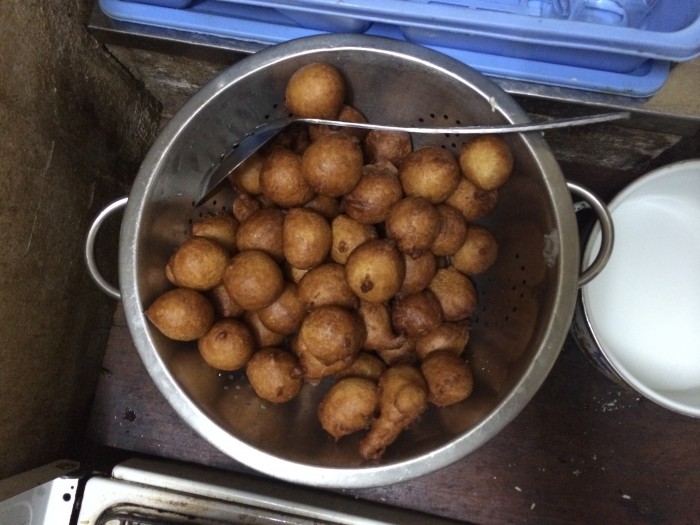
On many mornings for breakfast, I find a plate full of beignets on the table in my host family’s home. It tastes almost like donut. Many Cameroonians traditionally eat it not only for breakfast but also snack. There are a variety of beignets. For example, some are plain but have crispy crusts while some others have cream inside it along with sugar on the outside.
My host mother taught me how to make beignets. This particular beignet recipe creates very crispy crusts, offering a very scrumptious taste. It’s incredibly easy to make and can be done within one hour.
Ingredients
- 6 cups flour
- 1 cup sugar
- 1 teaspoon salt
- One packet yeast
- 1 cup warm water
- 1 big bottle palm oil
Instruction
- Mix the dry ingredients
- Pour warm water
- Mix the ingredients
- Put a towel or lid over the bowl and let the batter rest for 30 minutes to allow it to rise
- Pour the palm oil into a pot and boil it
- Drop about two tablespoons of beignets into the pot of Palm oil
- Take the beignet out when it’s golden brown
- Repeat step 6 and 7 until you use up all the batter
November 1st, 2014 by Rachel | Tags: Peace Corps | No Comments »

My brother and me when we were kids on Halloween.
Shortly after I arrived in Mengong, I showed my host family pictures of my life in America including old photos of me when I was little. One of the photos was my brother and me in our Halloween costumes and all ready to go trick or treating. My host brother was fascinated when I explained to him about the holiday.
A few days before Halloween, I reminded my host brother that Halloween was coming up very soon. He told me that he wanted to make a costume for Halloween and asked me if I could help. I told him, “Yes.”
The following day, in the afternoon, my host brother came to my training center, as he has done for the past several weeks from time to time. While I was in class, I quietly noticed my host brother pulling out crumbled up large papers used in our classes from the trash can. I then noticed that he was really onto something. After class was over, when I went over to him, I saw that he had created a cape, mask, and chest with muscles, all with paper from the trash can. He also used markers that were in the training center to draw out the muscles and the mask. Kids like him do really have big creative minds to create anything they wish to create. He went to the center all proud of being dressed up.
He dressed up again on Halloween Day. I was really in awe of him wanting to be part of an American holiday.
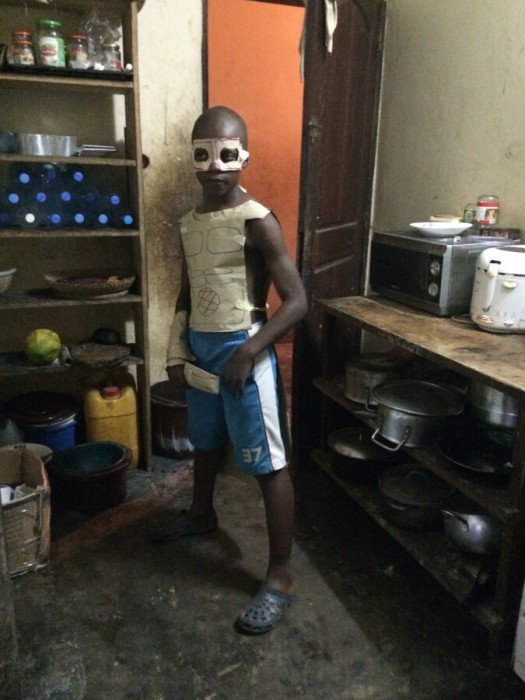
My host brother in his Halloween costume.
Tonight, trainees and I will have our own Halloween party in Ebolowa.