October 15th, 2014 by Rachel | Tags: Peace Corps | No Comments »
As soon as we got off the train in Ngaoundere, we met up with Peace Corps Volunteers who were hosting us. When they told us we would be taking a moto to the “case,” I thought, “What the f***?! I have to take a moto so soon already?!” I did come to Ngaoundere prepared to take a moto as I brought my helmet with me and was told to expect to ride a moto, but I was not expecting to take a moto as soon as arriving there. I just wasn’t mentally prepared for it yet. As someone who loves being brave and adventurous, I was surprised that I was at first scared of taking a moto for the first time in my life. “I’m not sitting in the back,” I told everyone, “I want to be in the middle.” I was fearing of falling off of the moto. A very nice gentleman who is a Peace Corps Volunteer offered to carry my backpack and sit behind me. The moto can hold up to three people including the driver. I put my hands on the driver’s shoulders even though it’s considered impolite but because I was just a bit too scared, I still had to do it. I also found that I have to remove one of my cochlear implant devices because the helmet would not fit over my head with both on. They would just fall off as I put the helmet on. Even when I keep just one cochlear implant device on, it’s still a challenge to get the helmet on because I have to hold the device to my head to make sure it doesn’t fall off. One could say that I should get a larger helmet, but I prefer not to because the helmet would be too loose and would put me in greater danger. The helmet needs to be tight on my head to maximize my safety on the moto. So, I put my second cochlear implant device in my pocket.
We rode off during the sunset to the “case.” The case is Peace Corps’ very own “hostel.” It’s a place where volunteers can spend the night if they arrive via train to Ngaoundere too late to continue their commute to their villages or if they want to do some errands in the city. Because we all obviously arrived too late, we all stayed at the case. Two trainees and I could have gone to our host’s home since she already lives in the city, but we decided to stay at the case for the night as everyone was staying there. Once we arrived and I got off the moto, I thought, “Wow! Not bad!”
We all went out to dinner at a pizza restaurant where we got some real pizza. I took the moto for the second time to the restaurant, and I was still a little scared.
Yes, I got to enjoy cheese for the first time in a month, and I can’t even express enough how happy I was to be able to enjoy this great food! I got a cheese pizza with ham and mushrooms. It was absolutely perfect and tasted like any pizza I eat in the US.
We returned to the “case” via moto. At that point, I was feeling more comfortable on the moto but still preferred to sit in the middle.
The following day, my group went via a taxi with another group of trainees to visit their volunteer’s home in a village, Nyambaka, that was about 100 km outside of Ngaoundere. As we rode to the village, I gazed out of the window to view the beautiful scenery of the region. There were green hills with a few mountains everywhere we went. The scenery reminded me of Tuscany. I could picture Adamawa being a great place to build resorts with beautiful pools.
As soon as we got to Nyambaka, the Peace Corps Volunteer took us a on a tour of the village, introduced her neighbors and demonstrated an example of her work. She tested to see if children under five were well fed by measuring the circumferences of their arms. I was amazed to see how terrified some of the children were for just simply getting their arms measured. All children she measured have been well fed. Those who would have had abnormally small circumferences would certainly have had abnormally small circumference.
We then visited a health center where the Peace Corps Volunteer from Nyambaka works on daily basis. The health center is surprisingly opened 24 hours 7 days a week. They offer wide variety of interventions such as vaccination, treatments for malaria, and birthing. What was most interesting was that they do offer variety of contraceptions to women but many women have to get them quietly, without telling their husbands.
That night and the following night, we slept at a volunteer’s home in Ngaoundere. It was a nice big apartment with two bedrooms and a living room. It had running water and electricity.
The following day, we went via moto to another village where two Peace Corps Volunteers worked. This was my sixth time on the moto and by that time, I felt more confident and very comfortable to be on it. The ride was only 10 minutes. We visited a primary school and observed Peace Corps Volunteers teaching children about water sanitation and washing hands. I was surprised by how much information the children already knew. The biggest question I had in mind when observing was do the lessons translate to behavior change? In other words, if children know the information on the importance of washing hands, do they actually go out and do it? When I start my work next month, I will always be thinking about this question: “Will my work and ideas translate to behavior change?”
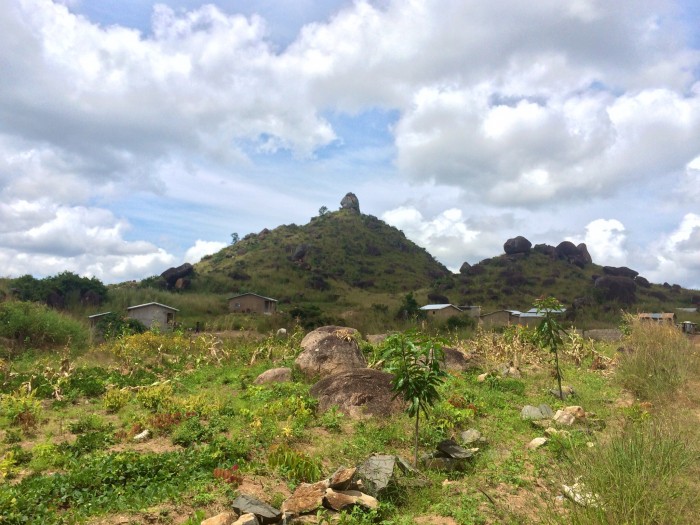
Mount Ngaoundere
Then on Saturday morning, on a beautiful sunny day, the Peace Corps Volunteer host, two trainees and I climbed to the top of Mount Ngaoundere. It was a great opportunity to work out and relax a little bit from several days of training. Taking the time to visit sights helps us fully realize what treasures a country can offer. Being on top of the mountain helped me fully realize how beautiful Cameroon, Adamawa, specifically can be. Seeing mountains, rolling hills and the blue sky with clouds made me fully appreciate where I am living now.
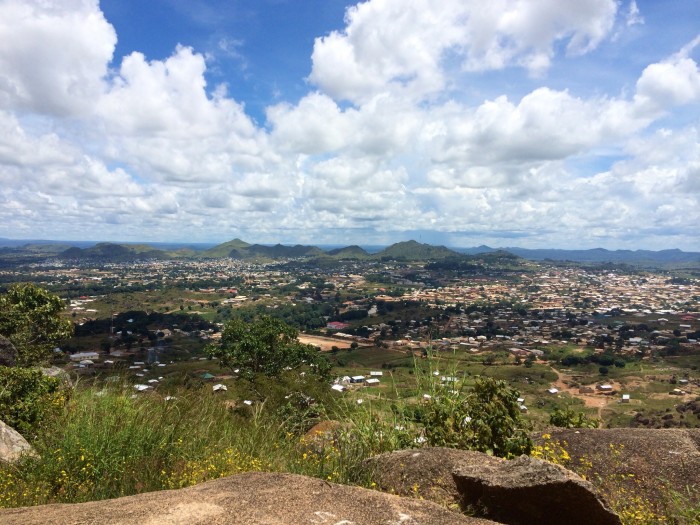
View from the top of Mount Ngaoundere
Before we departed via train on Saturday night to head back to Mengong, we visited a restaurant created by a Peace Corps Volunteer. Because it was an extraordinary project, it deserves its own blog post.
The train, believe or not, arrived about an hour early in Yaounde. Once we were in Yaounde, we took a taxi to a bus station where we boarded a bus back to Ebolowa. We requested the bus driver to stop by Mengong on the way back. We got dropped off on the side of the road, at the entrance to Mengong. We all had about a good 10 to 15 minute walk back to our homes. As soon as I got back, I took a very much needed hot bucket bath. It was so nice to see my host family again. They texted me a few times while I was away to check on me.
October 8th, 2014 by Rachel | Tags: Peace Corps | No Comments »
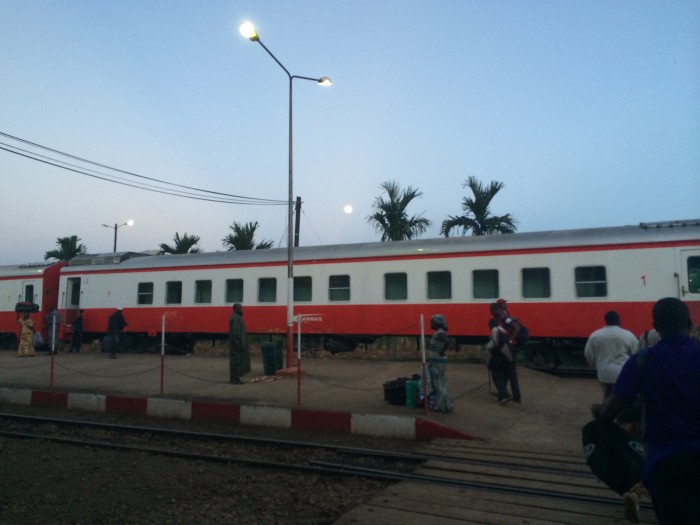
Boarding the train in Yaounde.
I joined the Peace Corps knowing that I was going to have to be very flexible and be willing to face unexpected events. I boarded a train yesterday evening in Yaounde to head to Ngaoundere, the capital of Adamawa, to visit a Peace Corps Volunteer to learn about the life and work at post. The train was suppose to depart at 6:30 pm but it didn’t depart until about 7:15 pm. We were supposed to arrive at about 9 AM in the morning and so of course since we left late, the time would be pushed back to probably about 9:45 AM.
All of us trainees were in first class which had rooms with beds. The train was clean and new looking. In fact, the cars were recently replaced. There was also air conditioning. Shortly after the train had left, I went to the bathroom. “Whoooossshhhh!” Hearing the toilet flush sound was seriously the best sound ever. It was nice to take a break from pouring a bucket of water into the toilet.
After chilling on my bed and listening to music on my iPhone for a couple hours, I went to sleep. If I was traveling alone, I would have kept my cochlear implant devices on due to safety concerns, but because I was with 10 other trainees who were traveling with me to Adamawa, I decided to just take my cochlear implant devices off and put them in my pockets for a few hours so that I could get some decent sleep in spite of the bumpy ride. However, the train had stopped a few times for a long period of time along the way. I didn’t know why at that point.
While sleeping, I dreamed that the train was having technical difficulties, and it was heading back to Yaounde.
Shortly after I woke up at about 5 AM in the morning, a trainee tells me, “The train is 10 to 12 hours away from the destination.”
“That’s so Africa,” I said, “Is that what was all that long stops about?”
“Yes. They made announcements that there were technical difficulties,” she said.
“Ugh,” I said, “But we’re in Africa.”
Many countries in Africa have a very well known reputation for not being prompt. In the African culture, in general, people do not allow time to stress them out and are very flexible. They go with the flow and just think about the present. I’ve been told that I will face many situations in the future where meetings will start at least a couple hours late. I have been advised to bring a book to meetings because I could be sitting and waiting a long time for people to arrive.
And how funny that my dream was half real?
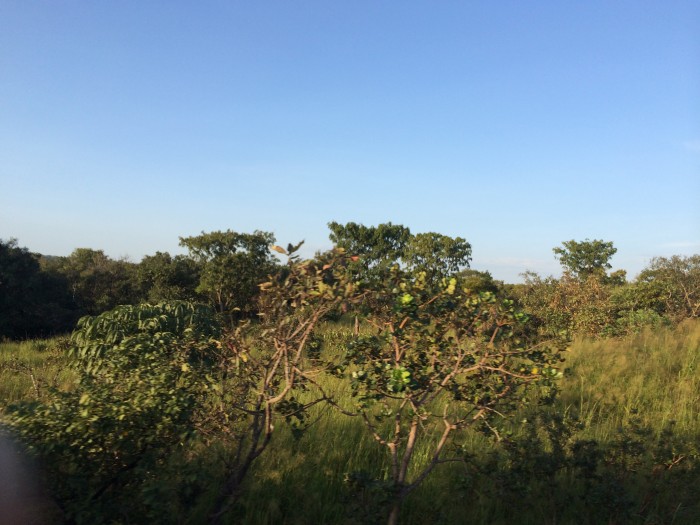
I then enjoyed an omelette and croissant for breakfast on the train. Then I just lied down and plugged an earbud into one ear to listen to music off and on and also chatted with other trainees. I also did spend some time gazing out the window and photographing the beautiful sceneries of Cameroon.
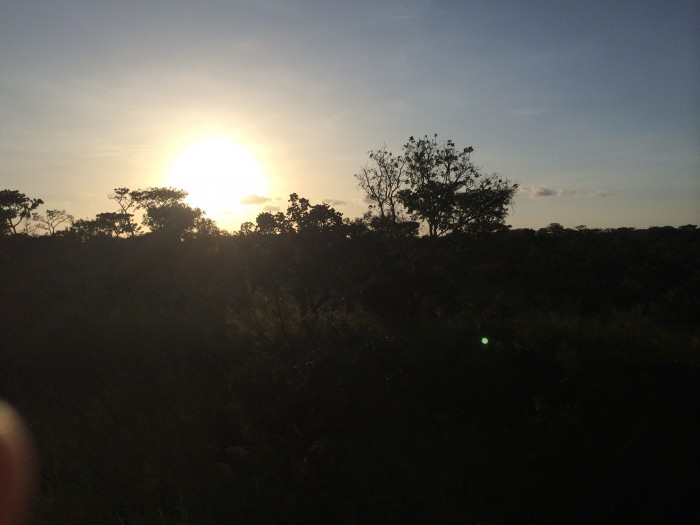
We finally arrived in Ngaoundere at almost 6 PM in the evening.
October 7th, 2014 by Rachel | Tags: Peace Corps | 1 Comment »
A few weeks ago, just when I finished my hot bucket bath and wrapped a towel around me, I looked up and saw a bright yellow creature. A lizard was crawling on the wall above the door. I bit my tongue to ensure that I would not let out a scream. I quickly gathered my items and rushed out of the bathroom.
Then a couple days later, I dropped a pen by my bed. I kneeled down to pick it up and then found a huge dead fly under my bed. A couple weeks later, I found another dead huge fly in front of my bed. Does that mean my bed net is doing its job in killing bugs as it has this chemical thing on it to kill bugs?
On the way back to Mengong from the big training center in Ebolowa one afternoon, when we stopped at a checkpoint, a man came up to van, right by the windows and held a snake with its head chopped off. Some of us trainees shrieked out and screamed.
Because I told my host siblings the snake story, they decided to come to my room a couple days later with a snake. When I saw them holding a snake, I squealed! They giggled and shook their head “No.”
“Oh! It’s just plastic?” I said.
It sure was just fake. However, I did learn that Cameroonians do eat snakes. But I’ll never try them because Peace Corps Trainees and Volunteers are not allowed to eat bush meat. To be honest, I’m grateful for the policy.
One can say that these experiences of finding creatures are not worth for the two years of Peace Corps service. We need to remember that every destination has its own share of problems but also wonderful treasures. All the wonderful things we’re offered and we’re doing truly outweighs discovering things that may not appeal to us. I am currently loving in learning about how I can help educate people about preventing malaria, vaccination, and nutrition while also immersing myself in a new culture.
I should add a very positive discovery – Cameroonians in general are super clean people. I am having a hard time understanding how they can keep their white clothes completely free from dirt. I have also spotted Cameroonians cleaning their shoes outside. I also always spot my host family regularly cleaning the floors of their home and keeping their home tidy.
October 2nd, 2014 by Rachel | Tags: #ThrowbackThursday, Peace Corps | No Comments »
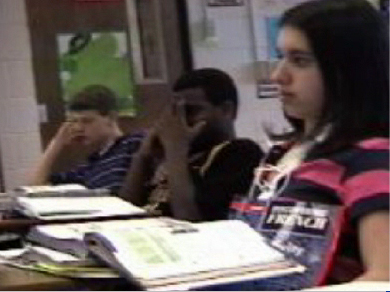
Me in my French I class during my freshman year of high school.
“The greatest pleasure in life, is doing the things, people say we cannot do.” Walter Bagehot
What if I had not refused to accept the word “no” when I asked if I could take French during my freshman year of high school? Where would my life have been today? I really don’t know.
You see, 12 years ago, when I was in eighth grade and at a meeting with the head of special education department, two teachers of the deaf, audiologist, history teacher and my mother to discuss my transition as a person with hearing loss from middle school to high school. When we were discussing my schedule, I had noticed that one class I longed wished to take was missing. “What about foreign language,” I asked, “I want to take French.”
“You should wait until 10th grade to take it,” said the head of special education department, “The class moves too quickly, and it’ll be incredibly difficult for you with your hearing loss.”
“No, I still want to take French,” I said.
My mother looked straight at me and said,”You should wait until 10th grade. High school will very hard and the transition will be tough.”
“I still want to take French,” I said. Everyone else in the room looked at me and said no too. I burst into tears and said, “I want to take French.”
The head of special education department finally reluctantly agreed to let me take it in my freshman year. “I hope you’ll get an A in the class,” she said.
Not only did I receive an A in French I, but I also went onto taking French honors during all four years of high school and one semester in college and receiving an A in all French classes. I lived with host families in various parts of France during my college years and also studied in Provence for two semesters.
I’m now living in Cameroon and speaking French on daily basis as part of my job.
For every time you accept the word, “No,” you could be closing a door to wonderful opportunities in life.
September 30th, 2014 by Rachel | Tags: Peace Corps | No Comments »
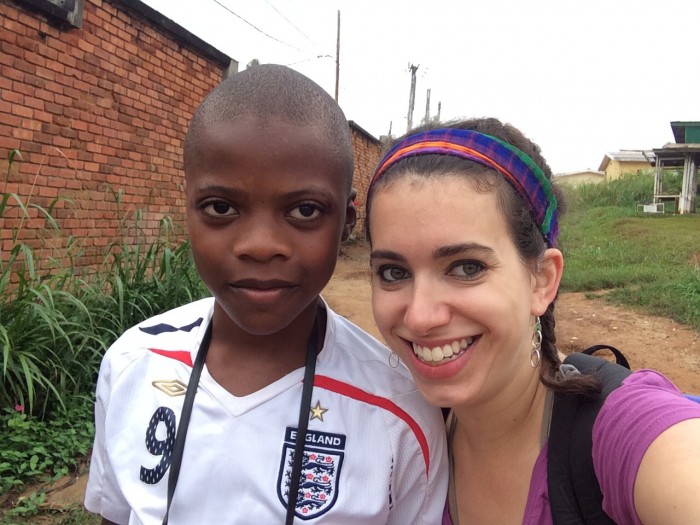
Me and my host brother, Riki
My host brother, Riki, has become like a best friend. Every men and boys should look up to this 11 year old boy who know how to treat women with such a tremendous respect. While in most traditional families in Cameroon, boys and men sit and not do any household work when at home, Riki comes to me almost everyday and ask me, “Can I help you with something today?” or “Can I help you with laundry?” or “Can I help you get water?” He has been helping me get water and do laundry. Every time I try to insist that I can carry the water or pump the water, he smiles and insists “No” and that he should do the work.
Riki does his own laundry. He helps the family get water. My host father helps with the cooking. A 17 year old cousin who lives with my host family cleans the floors every single day, irons clothes and helps with the laundry.
One of the biggest discussions in my training classes is gender roles and how they differ in the US and Cameroon. While I have learned that women and girls usually do all the housework which includes laundry, washing the dishes, cooking and getting water in Cameroon, I have noticed that my host family is quite unique. There are three different types of families in Cameroon – polygamous family, traditional family and modern family. Polygamous family usually means a man having more than one wife. A traditional family in Cameroon means a couple having at least eight children. A modern family in Cameroon means a couple having about six children or less. While in the traditional and polygamous family in Cameroon, women and girls normally do all the house chores, in the modern family, men and boys also do the housework. My host family is clearly a modern family. While the parents have four kids, ages 11 to 16 years old, living at home, they also have a 20 year old son who is living in Doula to attend a university. There is also a 17 year old male cousin who lives with the family.
Other trainees have told me that they find that women and girls do all the household chores in their homes and the men and boys just sit and chill out. I finally one day asked the 17 year old cousin why the males in my host family do household chores. I told him that I think it’s great that he and other males in the family help out. He told me that it’s because they’re from the West region and men there typical do the housework too. However, when I asked the mother, she had a different response. She said it has nothing to do with where they’re from and it has more to do with just them as a unique family. She also explained to me that in most parts of Africa, women do typically do all the housework. My language teacher said that she think it has to do with the family’s level of education. The father has a bachelors degree and is currently pursing a masters in financial administration. He’s also a math teacher and vice-principle at a local high school. The oldest son is attending a university. The children seem to take homework seriously, especially the 17 year old cousin. I asked the oldest daughter who is 16 years old what she’d like to study after high school and she said medicine and would like to be a surgeon.
My language teacher mentioned to me that her family was also unique too since her father and brothers always shared household responsibilities and she believes that it’s the level of education that influences the gender roles in families.
I want to add that Riki comes to the training center with me on Saturdays and watches my classes from the window which is always open. He is always so enthusiastic about meeting other trainees and learning about our work. He will often come to me and inform that he saw “mes amis” at the village center. Riki will ask me interesting questions such as what is the difference between the US and UK and who started the Peace Corps. Some of these questions has led us to interesting and complex conversations such what happened during the civil rights movement in the 1960’s in the US and how the US was founded.